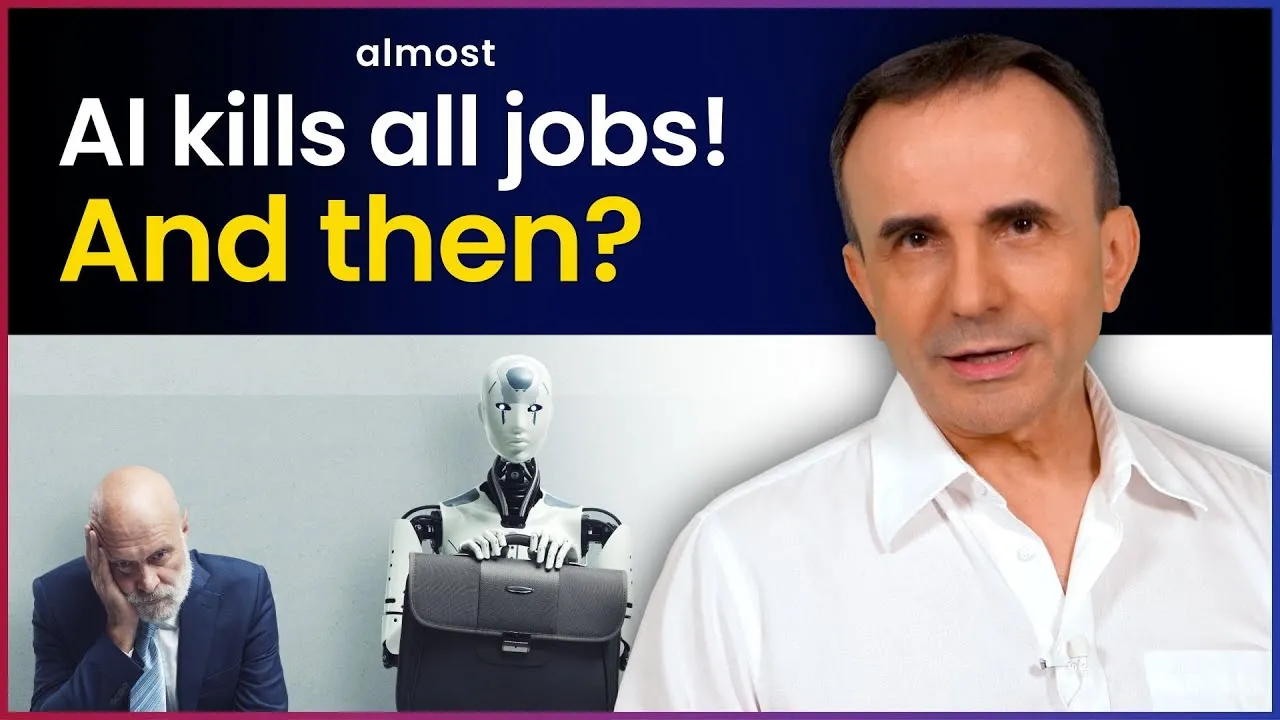
Will AI and robotics lead to a poverty catastrophe or prosperity for all?
How do you earn your money today? Whatever your answer, AI and intelligent robots will take over more and more human tasks. And they will do them better, faster and more cheaply. Yours too. Many people will work much less or no longer at all in normal jobs. And earn less to nothing. But what will you live on then? What about your colleagues and employees? Will we coach the robots then? Or how will we pay for our livelihoods? And how are our companies supposed to survive? That is the central future question of our time!
Come with me on a journey of insight into the future. Together, we will look at three scenarios for the future world of life and business. If AI and robots work for us on a mass scale, our future could be outstanding. The highest quality of life, without work stress and with more time for family, joy and hobbies. But it could turn out very differently. We could also wake up in a horror scenario.
First, we humans are a very short-sighted species with very little future intelligence. And second, there is a huge and catastrophic flaw in our economic system that could lead to disaster in a world of AI and robotics. Correcting it is the greatest challenge. You will find out what that flaw is in this article.
Klicken um YouTube-Video zu laden. Dabei wird Ihre IP an YouTube (USA) übertragen.
Datenschutz
What will our future with AI and humanoid robots look like?
In recent months, I have published several articles about the future with AI and humanoid robots. I link to the articles at the end of this post. Here is a compact summary of my messages:
- Within a few years, AI will surpass the intellectual work performance of almost all humans. By now, most players in the AI world broadly agree that AI that is more intelligent than all humans combined is only a few years away.
- Humanoid robots will quickly surpass the physical capabilities of all humans. More agile than Olympic athletes and with the dexterity of the world’s best surgeons. Precisely because they are modelled on the human body, their greatest advantage is their universal usability. Your robot tidies up your garden, then cooks your dinner, then irons the laundry, then plays with your children and tells them highly personal bedtime stories. Without holidays, sick notes, bad days or lapses in concentration.
- Humanoid robots will become superhumanly intelligent through AI brains. They can think, speak with us, learn and be creative. This is no longer science fiction. In one or two years, we will see thousands of them in factories. Later, many millions and even billions.
- The cost of humanoid robot labour will be unmatchedly low. I have set out the cost per working hour in detail in another article. You can find the link at the end of this post. Initially around 14 euros, later 10 euros and in the medium to long term less than 5 euros per hour. And they do all this without complaining about working hours, calling the union about work-life balance or dealing with low self-esteem in therapy. That means companies will have no real choice in competitive markets but to use humanoid robots.
- AI makes work more efficient, but above all more productive. Quality of life and prosperity rise sharply, at least potentially.
- Intelligent robots will initially solve the global labour shortage. It is likely that in many developed countries the labour shortage will simply disappear.
- Because of AI and intelligent robots, very many people will work less or not at all. This time, new jobs and tasks will not emerge quickly enough to offset the losses. Because AI is developing so enormously fast and because new jobs and tasks will also arise with AI support from the outset.
- In the long run, most people will earn significantly less or no income at all from work in traditional jobs. If you no longer earn money, you can no longer buy food or pay your bills. A fatal downward spiral.
What happens to incomes in an AI and robotics economy?
What are the consequences of AI and robotics in today’s system if we do not change it? You earn your own income from one or more of the following types of income.
1. Work: Salary as an employee or fees as a self-employed person
- In the medium to long term, up to 80% of the tasks people do today will disappear. Slightly fewer for the self-employed, because many of them can find and develop new fields of activity more easily than employees within their company.
- Some workers will have higher incomes than today, namely for work that requires especially high-level and unmistakably human qualifications. For example, the best strategically minded software developers, the best consultants or the best leaders.
- In the past, we have repeatedly created new professions and jobs. Professions such as weavers, coachmen or stenotypists disappeared, and yet we did not experience mass unemployment, because entirely new industries, professions and tasks kept emerging. This time too, there will be new jobs and tasks for people. Both in AI and robotics and beyond. But this time it will not be the case that virtually exactly as many new jobs and tasks arise just as quickly as old ones disappear. This time there are three key differences:
- The change driven by AI and robotics is so fast and so radical that demand for human labour is falling far faster than new jobs are being created.
- The new jobs and tasks will be designed from the start so that people have to do as little as possible.
- Most people cannot develop their skills as quickly as the demands on human jobs are rising. For the time being, we unfortunately cannot simply install an upgrade. Only the robots can do that.
That is what sets this transformation apart from earlier technological revolutions. And despite all its benefits, that is what makes it so dangerous.
2. Entrepreneurship: Returns from entrepreneurial activity
- If people’s incomes fall this sharply across the board, they can buy less. That leads to a drastic collapse in revenues and therefore in company earnings. They incur enormous losses and go bankrupt one after another.
- Prices will also rise for especially demanding corporate services. If they require high-level human qualifications.
- And there will be new business areas for companies. Directly in AI and robotics and also beyond. Although in future every business area will truly be driven by AI and robotics.
3. Ownership of productive assets: Returns from shareholdings, increases in the value of company stakes, income from rents and licences
- Anyone who owns productive assets also depends on there being customers, tenants, lessees and licensees for them. But if their incomes collapse, these returns also collapse massively. Stakes in companies, whether held directly or via shares, lose value drastically. That also hits private retirement provision. Real estate also loses value drastically if rents can no longer be paid. Selling then brings catastrophic losses.
4. Ownership of unproductive assets: Returns from increases in the value of commodities, art or crypto tokens, interest on deposits or loans granted. I see money as an unproductive asset because interest rates, at best, merely offset inflation.
Unproductive assets also lose value. If demand drops sharply, the value of commodities, art and probably cryptocurrencies will also collapse. Money assets are different. Since prices will fall sharply, cash becomes an advantage.
5. Unearned income: Pensions and retirement payments, maintenance payments, transfer payments such as citizen’s income or housing benefit.
6. Free services: Transfer services such as free schools.
Unearned income and services can only be paid and provided if the state has sufficient revenue. In many countries, pensions are paid from the contributions of people still in work. Their incomes collapse, so payments into pension insurance collapse too. The state also lacks the tax revenue needed to top this up. The state also lacks money for social payments such as citizen’s income, housing benefit and child benefit. And of course, people obliged to pay maintenance can also pay far less or nothing at all.
7. Price effect: This is of course not a source of income, but the price level determines the purchasing power of your income. In other words, how much it allows you to afford.
The only strongly positive factor is the price effect. If most incomes collapse, less is bought. There is an oversupply of products and services. Prices fall. That is economic deflation. Added to that is technological deflation. Products and services created with AI and robots will be much cheaper. Because most personnel costs disappear. AI and robots can also be scaled massively. Just as we have long seen with computers, monitors, solar cells and batteries. Then everything could cost only a fraction of today’s prices. That softens the income loss. But not fully.
How could this play out for the economy and society? Three scenarios
Let us imagine three scenarios for the next 10 to 20 years. You can think along and decide which scenario you consider the most likely.
- The horror scenario: the state and the economy have done practically nothing effective. Society experiences an economic catastrophe.
- The crisis scenario: the state and the economy were able to prevent the horror scenario. But a steep decline is unavoidable. Many nations will be too slow and too divided to act consistently. They will try to muddle through. But in doing so, they will fall behind and their citizens will become much poorer.
- The abundance scenario: the state and the economy used the opportunities with future intelligence and massively increased the quality of life of all citizens.
The horror scenario
We will experience this scenario if we change nothing. If we do not rethink work and income to address the effects of AI and robotics. This is what happens in the horror scenario:
- Incomes and assets fall massively. Falling prices are not enough. The state takes in drastically less tax revenue.
- Within a few years, a level of mass poverty not seen for a very long time emerges.
- Governments initially try to conceal the situation with expensive measures, which makes the crisis even worse.
- Everyone fights everyone. Extremism and conspiracy thinking gain massive support. People identify culprits and go after them. We fall back into a Stone Age society in a state of nature.
- Citizens elect radical parties to parliamentary majorities. Or they launch a violent revolution straight away.
- Totalitarian regimes and strong leaders seize power. In some countries from the left, in others from the right. They nationalise practically everything. Strong leaders decide what happens. Everything is brought into line. Products and services are rationed and allocated. The government decides what companies produce and at what price. As so often, some ethnic or social group is blamed for the catastrophe and targeted politically and privately. Whether far-right fascism or far-left communism, freedom dies.
Could a horror scenario really happen?
It is possible and it is also plausible. If we act stupidly about the future, irrationally, too little and too late. The horror scenario will not happen overnight. But if it happens, it will happen faster than any of us would like.
There are historical examples of this. At the beginning of the 19th century, textile workers known as machine breakers tried to stop industrialisation and the elimination of their jobs by storming factories and destroying looms, knitting machines and spinning machines. From March 1848 onwards, this led to a series of revolutions in Europe, including in France, Germany and Italy. They were very painful and life-threatening decades.
Do I believe the horror scenario will happen? Not necessarily. Most states will do something about it. But probably too late and too little. Because governments, like all people, behave very short-sightedly and are therefore often foolish about the future.
Why don’t we simply stop this development?
Technological change has never been possible to stop permanently. In the 1980s, a German political party refused to use computers in its Bundestag offices. Because it considered them an imperialist tool of exploitation. We will not prevent the very rapid development and spread of AI and intelligent robots, nor their effects. Quite simply because their benefits are so great and their costs so low. Even if we try to coordinate it globally. For example, we will not be able to persuade the Chinese to forgo AI and robotics that are superior to humans. Because they want economic strength and, from now on, they have to cope with the shrinkage of their population. We cannot stop the transformation. And it would in fact be rather harmful for us to try. Because, as I said, sooner or later AI and robots are exactly what will allow us to live in abundance.
The crisis scenario
The crisis scenario largely explains itself. It is hard, but not quite as bad as the horror scenario. Yet it is a long way from the abundance scenario.
The abundance scenario
The abundance scenario, with a massive increase in the quality of life of all people, can become reality. Above all, we must fix one decisive flaw in our economic system.
What is that flaw, you ask? It lies in the fact that our entire global economy is organised so that more than 90 percent of people earn income by selling their mental and physical labour as employees. They are almost always paid by time, with a monthly salary. Company owners, by contrast, can replace the labour of their employees with AI and robots. In fact, they have to, because their competitors in China and elsewhere will do the same. That way they can and will benefit from higher productivity. Employees generally do not have this option. They would only have it if they were paid according to their productivity when using AI and robotics. Or better still, if they themselves became entrepreneurs or co-owners of companies.
- If an economy shaped by AI and robotics is to bring more quality of life and prosperity for everyone, then we must manage to ensure that the gains in efficiency and productivity benefit all people. And we can do that by making as many people as possible owners of productive assets. We will look together at exactly how in the next article, the second part of this post.
- The high efficiency of AI and robotics drastically lowers living costs. A kilometre in a robotaxi for 20 cents will be cheaper than bus and rail, and the luxury coffee at Starbucks will cost only 50 cents. By far the largest part of the prices of every product and service consists of the salaries of the people who worked on it. Most of that would disappear, because AI and robots work faster and more cheaply than humans.
- AI and robotics will not only make us more efficient, but far more productive as well. Productivity means that with existing resources and our time, we can create much more benefit for people. History has proved that too. Almost every one of us enjoys a quality of life that would have been unimaginable for most people only a hundred years ago. The potential for more productivity is much greater than the potential for more efficiency in today’s system.
- The innovative power greatly expanded by AI helps solve central problems of humanity.We will find preventions and therapies for all kinds of cancer and many other diseases more quickly. We will develop new materials. Google AI DeepMind developed 380,000 new materials within just a few weeks. Without AI, that would have taken us several hundred years. We will develop new energy systems, make difficult sources such as geothermal easier to use and significantly increase the efficiency of solar cells. Energy will become affordable and sustainable. We might even find effective ways to stop and reverse human impact on the climate.
- We will find preventions and therapies for all kinds of cancer and many other diseases more quickly.
- We will develop new materials. Google AI DeepMind developed 380,000 new materials within just a few weeks. Without AI, that would have taken us several hundred years.
- We will develop new energy systems, make difficult sources such as geothermal easier to use and significantly increase the efficiency of solar cells. Energy will become affordable and sustainable.
- We might even find effective ways to stop and reverse human impact on the climate.
- Countless new professions, jobs and business fields will emerge. AI and robots process workflows automatically. But the new human tasks lie above all in direct service to people. We can care for one another far more and be there for each other.
- If we manage, at least to some extent, to shape the transition from today’s economic system to a new one with future intelligence, people worldwide will live in excellent health and in abundance. If people live in abundance, we also have a chance of lasting peace. Because wars and conflicts are almost always fought out of greed and over scarce resources.
We have the historic opportunity to create a life of prosperity and health for all people. The kind the super-rich live today. And on top of that, without harm to the biosphere or to other people.
Quality of life is the only thing that may keep growing forever. To achieve that, we do not need to consume ever more resources, damage the environment and put ourselves under ever more stress. AI and robotics will bring us ever closer to a fully circular economy without waste and without resource exploitation. Useful innovative power and productivity are the most important factors for the prosperity of a person, a company and a state alike. That is exactly what AI and robotics are for.
In the very long term, every nation and society will ultimately live in the abundance scenario. That is the beautiful and positive part of it. But based on all experience with the lack of future-intelligent behaviour shown by many governments and, yes, also voters, only some states will manage to spare their citizens the valley of tears on the road to the abundance scenario.
Summary: So what now?
I hope I have made clear what unimaginably great changes lie ahead of us. This is not science fiction. It has already begun.
But it may well be that we experience all three scenarios one after another. First the crisis scenario, then the horror scenario. And finally the abundance scenario, if governments, companies and citizens really act consistently with future intelligence.
Every person will be affected and involved. You too. Think about what you can already do today to prepare for these changes. And even benefit from them. We will think that through together in the next article.
The chance of the abundance scenario is tangible and real. If, yes IF, we make it possible for all people to benefit from AI and robotics. To do that, we will have to change our economic system. No, not towards socialism. The economic system that is right for the future will not be shaped by scarcity, restriction and distribution. Quite the opposite. It will be a system with the greatest imaginable freedom and quality of life.
We will think that through together in Part 2, which you can find here. There I also show what you can do today to make yourself more future-proof.
I wish you a brilliant future: Have a bright future!
If you want regular practical tips and strategies for your future management, free of charge of course, become a member of our community „Bright Future Leaders“.
Here you can find the other articles on AI and robotics:
– Humanoid robots: The solution to the labour shortage? (Part 1)
– Humanoid robots: How intelligent will they be? (Part 2)
– Humanoid robots: How will they learn? (Part 3)
– Humanoid robots: How much will they cost? (Part 4)
– Prosperity through AI, but how? (Part 2)
– AI and robotics: Income without work – how we will finance it! (Part 3)
– Securing income in the AI economy. 13 recommendations (Part 4)