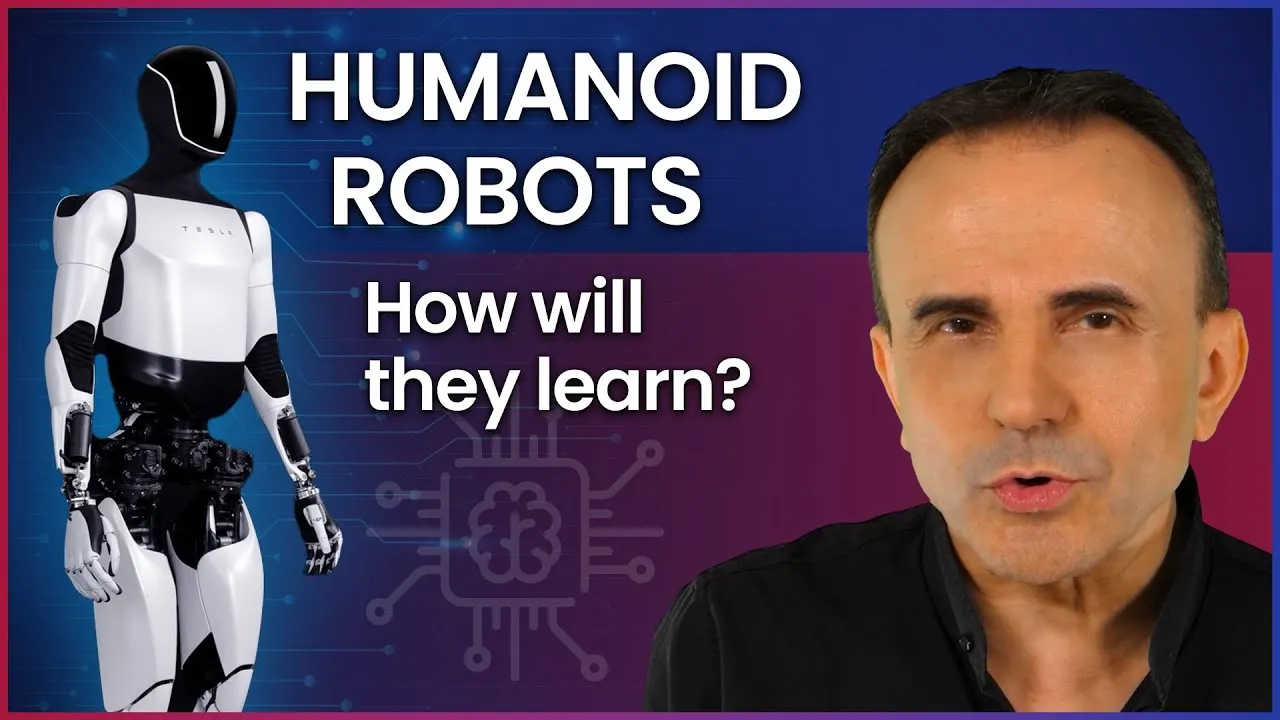
How will humanoid robots learn? How will they become intelligent? And how quickly will it happen?
Do you have the next technological revolution on your radar? Intelligent humanoid robots. They will fundamentally change our world of work and, with it, society. As always with such useful technologies, we will not be able to stop them. You and your company need to start preparing for this new era now.
Klicken um YouTube-Video zu laden. Dabei wird Ihre IP an YouTube (USA) übertragen.
Datenschutz
Humanoid robots: first prototypes in use
The first prototypes of humanoid robots are already working at quite conservative companies. At Mercedes, Apptronik’s Apollo is at work. At BMW, Figure from Figure AI is being used. And Nio has recruited humanoid robots from UBTech. It all still looks rather clumsy, but it is a promising start.
In the first two articles on humanoid robots, I answered two questions: Will the physical capabilities of humanoids be sufficient to take over practically all physical work? The answer is a clear yes. And will they be intelligent enough to do everything for us? Here too, the answer is a clear yes. The longer-term our thinking, the clearer it becomes that millions, and even billions, of humanoid robots will be working for us. You will find the links to the first two articles in this humanoid robot series at the end of the article.
The Chinese government wants humanoid robots to become world market leaders within the next three to four years. Specifically, with robots that can „think, learn and innovate“. Learn and innovate? How is that supposed to work?
Intelligent humanoid robots learn directly from the human body
With a motion-capture suit, it is possible to capture a person’s movements in detail, transfer the data to a robot’s neural network, and train it in this way. This is how robots, for example, learn to dance so well that they can then teach us to dance, with all the patience that some talentless dance students require.
If you have fed in thousands or even millions of work sequences from a plumber or – even more simply – an assembly-line worker in this way, the robot can do it too. Even better, in fact. And the other millions of robots simply copy this ability. It is only a matter of time and computing power before we can teach a humanoid robot virtually every human movement in this way.
Intelligent humanoid robots learn by observing humans
In concrete terms, this means that the robots simply „watch“ videos of good work. This is called imitation learning. Tesla has been training its AI for autonomous vehicles end to end since version 12 of „Full Self Driving“. The neural network watches millions of hours of 360-degree videos showing how good drivers act in a wide range of situations. How do you know which drivers are good drivers? Tesla identifies good drivers through a Safety Score. Anyone who follows too closely, drives too fast, often receives collision warnings, and brakes hard is far from the maximum score of 100. Their videos are then not used to train the AI. Other companies are pursuing similar approaches. But Tesla has by far the largest treasure trove of real-world video data of any provider in the world. More than 5 million vehicles collect unimaginable amounts of video data every day.
How do you train situations that occur extremely rarely? Through text to video. Sora from OpenAI shows how you can generate any video you want with just two or three lines of text. Text to 3D will work in a similar way. In this case, the AI generates a virtual simulation. This allows developers to simulate even the craziest traffic situations, in other words to create artificial videos for training the cars. This brings them ever closer to their goal of making the AI drive ten times better and safer than a human.
Exactly the same AI technology that is performing better and better in extremely complex city traffic is now going into the brains of humanoid robots. What is easier? Driving in a big city or working in a factory, in skilled trades, in the garden, in hospitality, or in the home? Exactly. What a robot needs to be able to do is less complex in each individual skill than navigating city traffic. And what is less dangerous? So that the bots can be introduced with a greater willingness to take risks, and therefore much faster? Exactly. Because autonomous driving is already so far advanced, humanoids will soon be working in factories, then in service, and eventually in our homes.
We were already saying this back in the 2000s: robots will learn like children. Through imitation. By watching us live or seeing videos of our activities and copying us. How do people operate this production machine? How do people deliver parcels? How do people load and unload a dishwasher? Every household has different strategies for that, especially for loading it :). With millions of hours of 360-degree video as input, the AI robot will very quickly become better and safer than any human.
Intelligent humanoid robots learn on their own
AI and robots have been trained through machine learning for decades. But now they are increasingly learning on their own. Through what is known as reinforcement learning. They are rewarded for success and punished for mistakes. They are autodidacts. Then they do not even need us humans as teachers.
Do you remember how the AI AlphaGo defeated the world champion in the game of Go? Go is far more complex than chess. Since 2019, human Go players have had no chance against AI. The AI acquired this ability virtually on its own, without humans having to train it. It takes half a human lifetime, 30 to 40 years, to become a Go grandmaster. AlphaGo became a super-grandmaster in just 40 days. Without a human teaching it.
A team at Google Deepmind had already succeeded in 2021 in getting an AI to teach itself how to play football. At the beginning, the AI players were still incompetent, wildly twitching digital beings. With their 56 joints, they first had to learn to move like real humans. To do that, the AI was simply shown 105 minutes of football match videos. From this, the AI players learned to move perfectly. After three days of training, it already looked significantly better. Those three days correspond to 5 years of simulated matches. At first, the AI players learned how to handle the ball, dribble, and predict the ball’s path. And after 50 days of training, in other words after around 80 years of simulated matches?
The AI players learned to recognise and understand the movements of the other players. And finally, the AI players learned to cooperate with each other to win against the opposing team. They learn from mistakes and successes how to score goals most effectively. The number of goals was defined as the reward. There is technically nothing standing in the way of expanding this to 22 players with a real out line, offside rule, and so on, other than computing power and energy.
Transferring these astonishing AI capabilities to the body movements of robots is, of course, anything but easy or simple. But AI also helps with that. And lots of training time. Note that the initial tasks of humanoids will lie in production and logistics. And those are significantly less complex than a football match.
This type of learning has practically only three limiting factors. The availability of videos of the activity to be trained. The corresponding computing power and the energy. More and more billions in investment are flowing into obtaining data, into AI chips, and into renewable energy. With these enormous investments, all three factors are becoming almost unlimited in availability.
Intelligent humanoid robots learn from one another
We humans each have to learn our abilities individually. That is why we spend many years in school, study, and complete apprenticeships and training. When an employee leaves your company, his or her knowledge is lost to your company. When we die, our knowledge and skills are lost to the world. The next generation can build on prior knowledge, but every single person has to learn everything all over again.
Not so with AI and robots. If one robot has learned how to load and unload dishwashers or make coffee, that ability can immediately be transferred to all other robots of the same kind. They do not even need to have been trained on all existing machines. They can infer how to operate an unfamiliar machine from operating a dishwasher or coffee machine. What a robot learns and masters can be stored as a skill and published on a platform for robot skills. Every robot from the same manufacturer can download this skill and immediately have the ability that other robots have developed. This will also work across manufacturers. For this, NVidia offers the Gr00t Foundation Model and the Isaac robot platform.
This transfer of abilities from one robot to another happens without years of training. And humanoid robots never forget or unlearn the ability. On the contrary, updates make them ever better at it. The only things they will forget in terms of knowledge and capability are what has become outdated. The abilities of AI robots accumulate. Human abilities largely have to be rebuilt again and again. It is impossible to overestimate the immense speed at which intelligent humanoid robots are becoming more and more capable. And all of this at minimal cost when compared with the cost of human labour.
And now what?
What does all this mean for you and your industry? What can you do now? We now know that the capabilities of humanoid robots will grow very quickly. Much faster than we can imagine today. In previous articles, we established that there are very good reasons to assume that intelligent humanoid robots will increasingly work for us because of their physical and cognitive capabilities. In factories, in logistics, on construction sites, in service, and also in our homes. A single humanoid robot can achieve up to ten times more than a human.
The world of work and society will be transformed enormously in the coming years. And with them your job and your company. Whether you manufacture something, work in logistics, are employed in a construction company, or run a restaurant.
If you and your team would prefer to keep everything as it is, if you resist necessary change for emotional reasons for as long as possible, your fears about the future will only grow. Those who see themselves as victims of change develop fears about the future. Of course, you do not have to turn your business upside down today just because humanoid robots are coming soon. But I recommend that you deliberately build well-founded excitement about the future within your team. Excitement about a new and fascinating era. Then transformation will be easier for you, faster, cheaper, and more enjoyable.
Let us summarise:
- First effect: More efficiency – fewer jobs: The same output can be delivered with far less human labour. That is efficiency. It costs jobs and raises many social questions, which we will address in another article.
- Second effect: More productivity – the same number of jobs: But with your team, you can also achieve much more. That is productivity, and it preserves jobs. When it comes to AI and robotics, focus above all on productivity. Then AI and robotics do not necessarily lead to fewer jobs in your company and in the economy. Can there be limitless productivity? Well, not if we mean ever more products and ever more resource consumption. But certainly if it means that people’s quality of life increases. Quality of life is the only thing that may and should grow forever.
- Measure: Redesign strategy and business model. In light of AI and humanoid robots, you will need to rethink and redevelop your strategy and business model. If only to avoid falling behind and to preserve your competitiveness.
- Recommendation: Start now – to stay in the game. Prepare yourself and your team now. Make sure you start already now to think through every element of your processes and learn how you can use AI and robotics productively in the foreseeable future. In the last article, I recommended creating a matrix with all your processes on one axis and the years up to 2035 on the other. Then enter, in percentages, your assessment of when and to what extent AI and humanoid robots will be able to take over the activities in each process.
- Your thoughts and questions: How do you see the future with humanoid robots? If you have ideas and questions, please write to me.
- Become a member of the Bright Future Leaders. This is our community of forward-looking leaders. You will regularly receive free tips and strategies to make yourself and your company more future-ready.
- See all articles on robotics here:
– Humanoid robots: The solution to the labour shortage? (Part 1)
– Humanoid robots: How intelligent will they be? (Part 2)
– Humanoid robots: How much will they cost? (Part 4)
– AI kills all jobs – what then? Three scenarios (Part 1)
– Prosperity through AI, but how? (Part 2)
– AI and robotics: Income without work – this is how we finance it! (Part 3)
– Securing income in the AI economy. 13 recommendations (Part 4)
I wish you a brilliant future: Have a bright future!