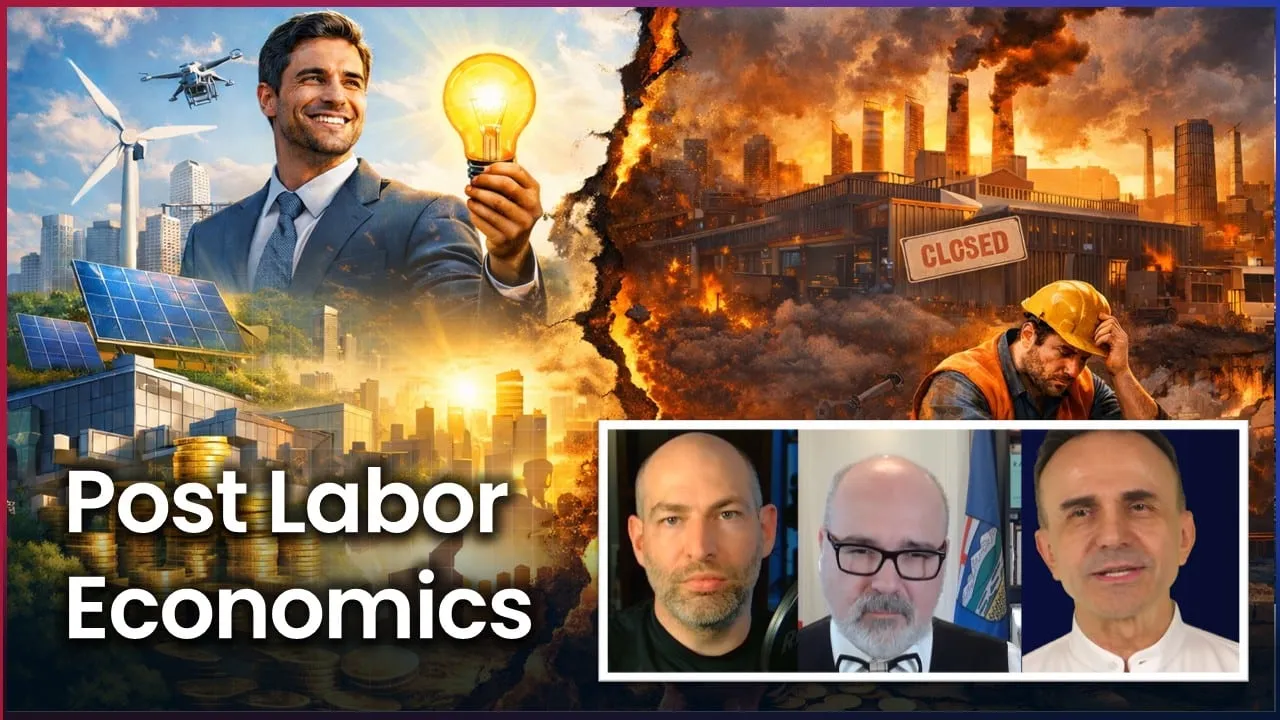
What happens to our economy when human labor is no longer the central factor of production?
What does it mean for companies when productivity continues to rise while purchasing power and demand come under pressure? And how should entrepreneurs and executives act when automation delivers efficiency gains but erodes their own customer base?
These questions are not a matter for the distant future. They are already shaping strategic decisions in companies, politics, and society today.
In this video, I speak with David Shapiro and Dalibor Petrovic about exactly this development.
Klicken um YouTube-Video zu laden. Dabei wird Ihre IP an YouTube (USA) übertragen.
Datenschutz
David Shapiro is a leading thinker on artificial intelligence, automation, and the concept of “Post-Labor Economics.” For years, he has analyzed the structural decoupling of productivity, employment, and wages—and why AI and robotics are likely to accelerate this development and bring it to an endpoint.
Dalibor Petrovic brings more than three decades of international management and consulting experience, including more than twenty years as a Senior Partner at Deloitte. His focus is on the concrete implications of this development for companies, owners, supervisory bodies, and leadership teams.
The conversation covers, among other things:
- why the current change is structural and not a cyclical phenomenon,
- what realistic time horizons executives should plan for,
- and how companies can deal with the tension between automation, productivity, demand, and social stability.
This interview is also a preview of the upcoming joint book by David Shapiro and Dalibor Petrovic, which will be published in May. In it, they develop the full conceptual model behind “Post-Labor Economics” and derive opportunities for course of action for companies, politics, and individuals from it.
This is not about distant future scenarios. It is about decisions that are being made today—or being postponed for too long.