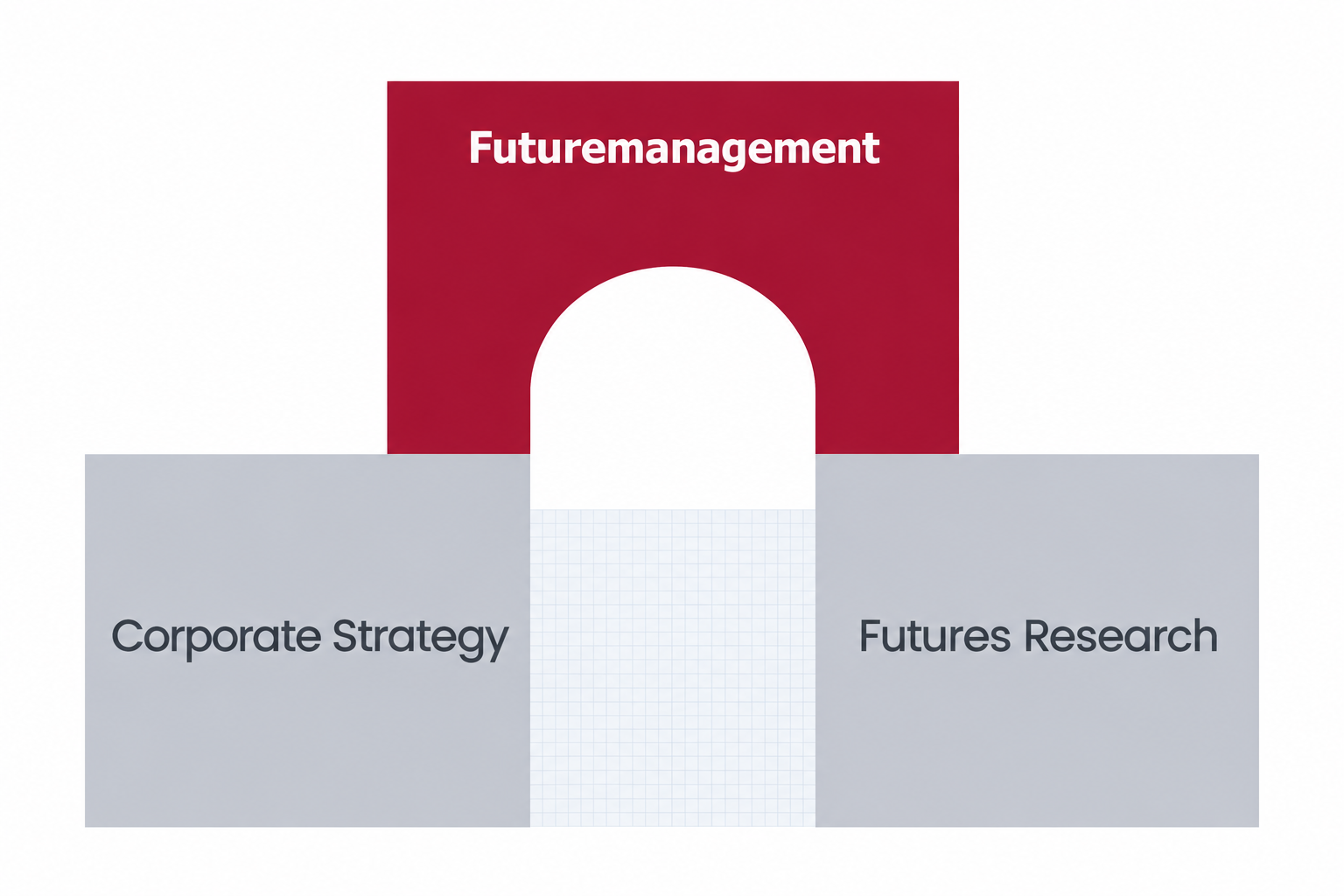
Futures Management is the entirety of all systems, processes, and methods for the Early Detection of future developments and their integration into strategy. Futures Management is the bridge from the practice of corporate management and life management to Futures Studies and back again. It turns pure Futures Studies into a holistic concept with interfaces to strategic and operational management.
- Futures Management closes the gap in understanding between the often abstract, nebulous, and non-binding future and trend research and the practical requirements of managers in companies.
- Futures Management helps to systematically analyze the future of society, economy, technology, politics, and the biosphere, to identify future opportunities from this, to develop future strategies, and to build future competence.
- Futures Management serves to recognize, evaluate, and use future opportunities. It helps to have more time in order to gain an advantage.
The Significance of Futures Management
How can something be managed that does not exist? You cannot grasp the future, measure it, weigh it, or count it. So can it not be managed either? We can only manage the future in our minds, because that is the only place where the future exists. There we find future assumptions, opportunities, hopes, fears, goals, and plans.
„It is the mind that builds the body for itself,“ wrote Friedrich Schiller in Wallenstein.
What begins today in the mind as the future becomes reality tomorrow. What today is your business, your success, and your balance sheet, you caused years ago on the basis of your future assumptions at that time and your perception of opportunities with your strategy. What you assume, perceive, decide, and do today about the future determines the quality of your future present.
You can expand, enrich, consolidate, and make your future knowledge more effective. So that you can decide, shape, and act more intelligently for the future.
That is Futures Management: a professional way of dealing with the future in your mind and in the minds of your employees. So that your future, and thus your future present, will be brilliant. But what significance does Futures Management have now? The following two questions address this:
- How many percent of today’s success depends on the long-term course settings from a few years ago? Answer: about 70%. What is interesting is: you can basically ask any audience – a similar figure always comes out.
- How many percent of our time do we spend seriously thinking consciously about the next 10 years? Answer: under 5%. This has been studied in companies, among managers, and also among life entrepreneurs. Now one might think: good heavens, these 2–3% are far too little. But that is not the case. It has settled at that level, and that is fine.
If you look at these two results together, you realize that with Futures Management you have a huge lever in your hands. Thinking a little about the future and making decisions can mean enormous success. But as we, and especially financial experts, know today, every lever can also work in the opposite direction. With goodwill and beautiful images of the future, I can drive my company into the wall. So the future is a personal, entrepreneurial, and societal responsibility that we have. And not just a bit of success technique and dreaming.
The Basic Principle of Futures Management
A single threat is small when it arises. But it grows over time if it is important and relevant. The effort required to transform this threat into an opportunity also increases over time. It is like cancer: if it is detected early, it is easy to combat. The later it is discovered, the more difficult and threatening the situation becomes. What about the opportunity? Opportunities – and there are more of them for companies today than ever before – are unfortunately not always so easy to detect. And every opportunity shrinks over time.
Every company has some kind of Futures Management in one way or another. It simply cannot be done without it. We all have assumptions, we all look into the future, we all have something like goals and visions. What we should do in the competition for Early Detection is improve the capabilities in our own Futures Management. To bring it to the point where we recognize opportunities earlier and at the same time protect ourselves from being too early. Because that is at least just as bad as missing an opportunity. So it is about strengthening ourselves in the competition for foresight.
Best Practices in Futures Management
Many practitioners avoid discussions about the future because they so often end in fog and chaos. The core problem is that there is only rarely a clear and precise language for the future. This gives rise to annoying and dangerous future confusion. As a result, methods and tools are often used in the wrong place and applied incorrectly. This is why strategic directions, visions, and strategies are often so imprecise and inconsistent.
With the Eltville Model, you solve the complexity problem in future thinking. The Eltville Model has proven itself in hundreds of projects and in countless companies and organizations, including governments. The Eltville Model is based on the five fundamental human motives for foresight, the five „futures glasses“.
Klicken um YouTube-Video zu laden. Dabei wird Ihre IP an YouTube (USA) übertragen.
Datenschutz
The sound and precise definitions of the five types of future and of the associated results and processes make professional Futures Management easy for you. That is what makes the Eltville Model so easy to understand, despite the necessary complexity. That also makes it so easy to connect with for your managers and employees. Even investors are enthusiastic because of the solidity of the strategies developed with it.
I wish you a brilliant future!
Have a bright future!