Why a trend system? Whether Tesla, Apple or Salesforce. Every major business success is largely based on recognising trends or possible trends at an early stage—and then creating a trend of their own from them. This is how new markets and successful companies emerge. What do you have to do with trends, and what do trends have to do with you? You and your company and profession must—or at least should—align yourselves with the changes ahead. Ideally, you should use them to your advantage. And of course, if you invest in shares for your retirement provision, you should do so too. Professionally managed companies systematically monitor and assess future trends. And you can do that too. It is even relatively easy.
At the end of this article, you can download an updated PDF of the trend system. The text and video show an earlier version.
Klicken um YouTube-Video zu laden. Dabei wird Ihre IP an YouTube (USA) übertragen.
Datenschutz
What exactly is a trend? A trend is a directional change in one or more variables. Global population growth, population decline in individual countries, the increase in global prosperity, the decline in the absolute number of people suffering from hunger and digitalisation—all of these are trends. Change is taking place in a direction that is at least broadly recognisable.
Wouldn’t it be useful if you could see all the major trends at a glance? In a sensibly structured trend system? So that you could find your bearings and stand on solid ground? This will make your job and business model fit for the future, and your decisions better! I am giving you a trend system that comes from practical experience—from my own and our practice at FutureManagementGroup. For 30 years, we have been developing future strategies for renowned companies. This trend system comes directly from projects of this kind. This is part 1, providing an overview of all the major trends. A quick overview to start with, featuring examples of powerful trends. Here you will find a description of all the trends and a download of the trend system as a PDF. In following articles, I will go into detail, show examples and cover sub-trends and surprises—in other words, trend breaks.
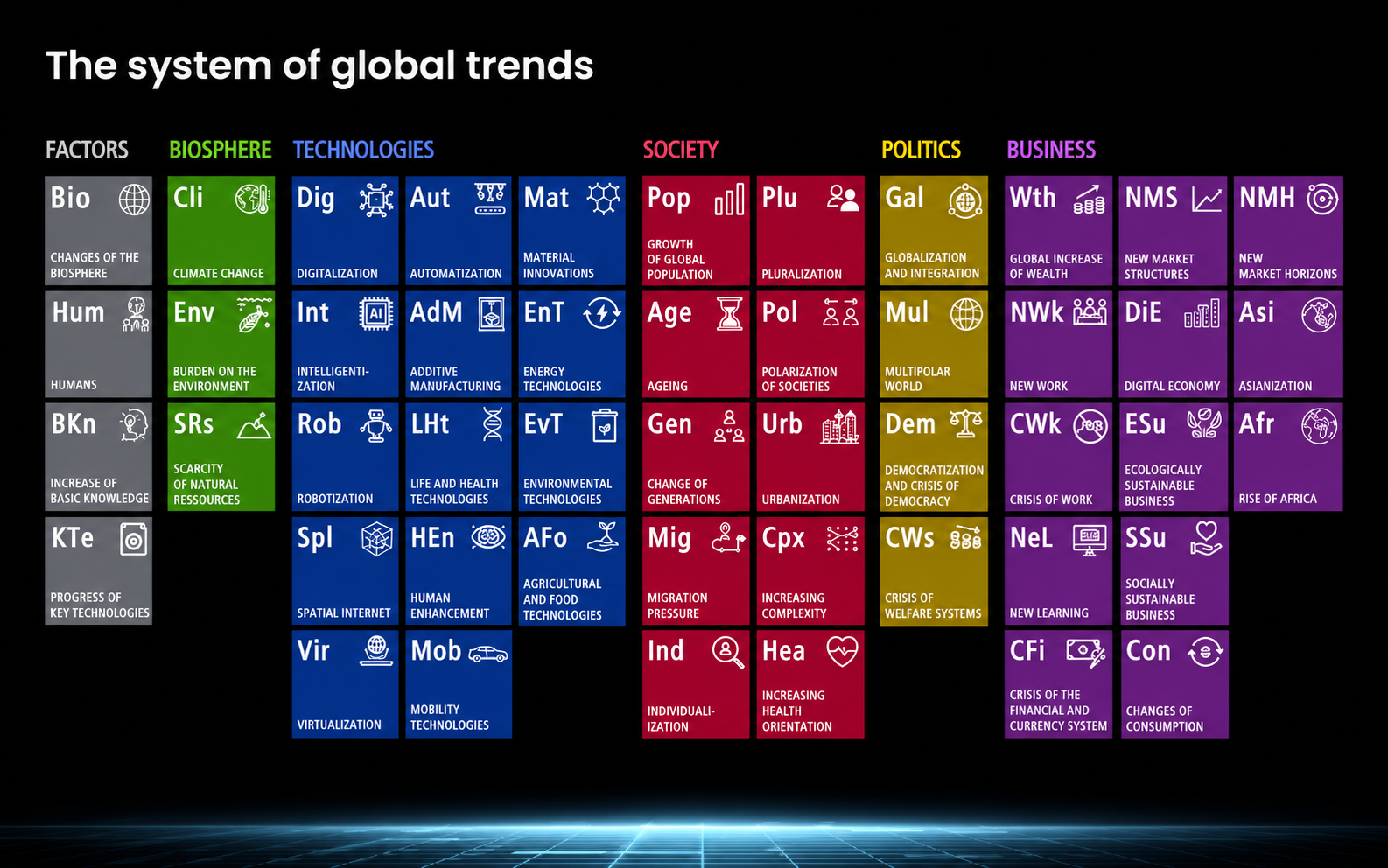
The FMG Trend System
We present trends like a periodic table of the elements. These trends are the elements from which the future of your business, your profession and your life will be made. Incidentally, we do not call them „megatrends“. There are several reasons for this, which I will explain in one of the following articles. We structure the trends into areas: biosphere, technology, society, politics and economics. We do this primarily because technologies must be considered separately. They are the fastest and, alongside human motives, the strongest forces of change. If you only have a list of megatrends, you would have to mention digitalisation and artificial intelligence for every single trend, for example. That is why we look at the individual elements of change. The allocation of trends to the areas is of course never entirely clear-cut, because practically every issue is made up of many of these trends.
Future factors
In the trend system, you first find the future factors—the drivers that trigger trends in the first place. These include human nature and its motives, the growth of humanity’s basic knowledge and advances in foundational technologies. For example, a new technology such as the genetic engineering method CRISPR CaS9 emerges and triggers a change, leading to more and more genetic modifications being made to plants, animals and ultimately humans. Whether we want this or not is another question. The technology is the future factor; the spread of the technology is the trend. Societal trends are similar: they are also triggered by future factors. The war in Syria led to the refugee crisis in Europe, which in turn strengthened right-wing populist movements. But the war in Syria did not simply happen without causes. Religion, oil and much more play a role. As you can see, the future factors behind societal, political and economic trends are far less clearly describable in cause-and-effect relationships than technological trends.
Biosphere trends
Our habitat is determined by the biosphere in which we live and which we also influence through our actions.
The existence of climate change is hardly disputed. There is a clear majority view on whether and to what extent humans are responsible for it, but there are also sceptics. Without doubt, among other things, we have released a great deal of CO2 into the atmosphere by burning fossil fuels. We would do well to reverse this, for example by removing carbon dioxide from the atmosphere and using it to produce fuels and materials.
Despite major advances, we continue to cause considerable environmental pollution. Some natural resources are becoming increasingly scarce. But it is also a question of definition: what do we consider a resource, and must we limit ourselves to the Earth’s resources? After all, the first companies are already planning to extract resources from asteroids. It is not so much the planet’s resources that are scarce as human reason and intelligence.
Technological trends
Alongside human motives, technologies are the most powerful forces of change. With our tools, we shape the world, predominantly to our advantage.
Digitalisation has been under way for more than 70 years, but only in recent years have many people become aware of how powerful and far-reaching this technological trend really is. And we have only just begun to digitalise our living environment.
We call intelligentisation the advance in performance and increasing application of artificial intelligence across practically all disciplines. This trend has also existed since the 1950s. AI will bring drastic changes over the next few years and decades. Sooner or later, everything humans can do cognitively, AI can already do—or will soon be able to do—better. But for now, only as highly specialised AI.
Like AI, robotisation has the potential to transform our lives from the ground up. For decades, futurists have been telling us that robots will do our work, including outside factory production lines. But only now is it really getting started. Everything humans can do physically, robots can already do—or will soon be able to do—better.
Spatial Internet is an emerging trend in which the internet—which has so far been practically flat because it hides behind displays and screens—comes into our three-dimensional world. We will be able to use the internet without looking at displays; we will use it without noticing that we are doing so. Many sub-trends belong here, from the Internet of Things to mixed reality.
Virtualisation describes the process by which more and more of what used to be physical and tangible is dematerialised. This ranges from books and audio recordings to all kinds of devices that we used to have as separate units—cameras, mixing consoles and buttons in cars. It also describes the virtualisation of schools and universities, business communication and leisure experiences. Software is eating the world, as the famous summary puts it.
Automation is an overarching trend that began with the automatic loom in the 18th century. Today, we automate not only machines but also software processes using AI, smart contracts—that is, if-this-then-that algorithms—and blockchains.
Additive manufacturing is better known to you as 3D printing. It is often almost unbelievable what can now be 3D-printed, from machine spare parts to a functioning heart. 4D printing is the next dimension, in which printed objects can continue to change after production.
Life and health technologies encompass medicine, biotechnology, food innovations and IT-supported innovations. Combined, they create solutions that will enable us to live significantly healthier and longer lives. This is a huge and promising field for future markets.
We include human enhancement, meaning the expansion of human capabilities, prominently here, because expanding our abilities has enormous consequences. Humans are improving cognitively, in other words in their thinking; physically, in their bodily capabilities; and sensorily, in their ability to perceive the world.
New mobility means that the way we move around will change significantly in the coming years and decades. Some sub-trends are electric mobility, autonomous vehicles, drones and hyperloops, with which we could travel at 1,200 km/h.
New materials drive innovation in many areas. Products become lighter, cheaper, harder, more durable, more comfortable and easier to maintain. They are even becoming more intelligent, right through to programmable matter. They are also becoming more environmentally friendly.
We need energy for everything. The development and spread of new energy technologies are therefore a central trend. Renewable energy is a significant sub-trend, as are new forms of energy storage and, yes, alternative forms of nuclear power.
Societal trends
Societies around the world are changing in size, structure and behaviour.
The strongest trend is still global population growth. Following an S-curve, humanity will continue to grow to 9 to 10 billion people by 2050, possibly beyond. It is not so much the planet’s resources that are scarce as human reason and intelligence.
Ageing is currently a tangible trend in only some societies, such as Germany, Italy and Japan. In the long term, however, ageing is an almost inevitable consequence of progress—and this applies worldwide.
A recurring trend pattern is the change of generations. From the Silent Generation, born before and during the Second World War, through the Baby Boomers and Generations X, Y and Z, to Generation Alpha, born since 2010. They all have very different life experiences and use them to shape their value hierarchies and behaviour.
The growing migration pressure from poor regions to rich regions, such as from Africa to Europe, will present us with much greater challenges than before—if we do not change our strategies.
Individualisation is a multifaceted trend. It refers to phenomena as diverse as the loss of a shared media reality, the customisation of products and mass customisation.
We call the increasing diversity of lifestyle concepts and cultural backgrounds within countries pluralisation. Societies are becoming ever more diverse. This also includes the dissolution of male-dominated societies in favour of feminisation.
At the same time, societies are becoming polarised. The economic polarisation between the upper and lower ends of income and wealth is one aspect. The polarisation that has become so palpable in recent years is socio-political in nature. It can be experienced in its extreme form in the USA—and not only since Trump.
Urbanisation means the growth of cities. More than half of the world’s population now lives in cities. By 2050, it will be two-thirds. The number of megacities is growing rapidly. Cities are sources of social innovation. But the challenges in transport, supply, the environment, energy and health are also enormous. Urbanisation also leads to greater disaster risks. The Covid-19 pandemic may slow urbanisation.
Many of the trends in this trend system have made the world far more complex than it was 20 or 30 years ago. And even then, people already thought it was complex. Increasing complexity will challenge and overwhelm many people even more. The massive spread of conspiracy theories is just one result. We will need to find ways and means of dealing with complexity.
Political trends
Politics acts and reacts to societies and people, and in turn shapes them.
Global value chains are being reconsidered and production is being brought closer again, but globalisation is not over. Integration—the coming together of economic regions in particular—is also increasing, as is currently happening in Asia. In the EU, however, we are currently moving in the opposite direction.
The world used to be politically simpler too. There was the free West and the socialist East. Today, and even more so in the future, we are seeing a multipolar world. Countries and regions that previously played hardly any role on the political and economic world stage are gaining importance, above all China, but also India and Indonesia.
For centuries—practically since the Magna Carta and at the latest since the US Declaration of Independence—a process of gradual democratisation has been taking place worldwide. Until a few years ago, it was uninterrupted. We expect it to continue, but must not overlook the fact that for several years we have been experiencing what is hopefully a temporary crisis of democracy, extending as far as autocratisation.
In almost all economies, social security systems are in a critical condition. The crisis of social security systems means that citizens’ entitlements are becoming barely affordable in many places. When all the Baby Boomers retire, pension systems may even collapse, or public debt may continue to rise—ultimately only delaying the collapse.
Economic trends
Last but not least, economic factors shape our future.
Global prosperity growth continues unabated despite all the crises. Global prosperity has increased steadily over the centuries, and this will continue. The number of people living in extreme poverty has halved since the mid-1990s in absolute terms, despite the fact that many more people now live on Earth. The great challenge is to make economic growth ecologically sustainable.
The old world of work was simple. A few people thought, and the many others did. Command and obedience, as in the military. That has not worked in an increasingly complex world for a long time. The new world of work is different. Those who work more agilely, quickly and flexibly win. And who offer purpose while valuing people as they are. The spread of new work and communication technologies is greatly reinforcing this trend.
The increasing automation of even complicated and complex tasks, especially through artificial intelligence and robotics, will gradually lead to a crisis of work. The crisis of work means that many jobs will disappear faster than similar jobs are created. In many cases, people who lose simple tasks to intelligent machines will not be able or willing to retrain quickly enough.
The crisis of financial and monetary systems continues and is becoming existential. The short-sightedness of financial markets repeatedly leads to crashes. The euro has design flaws. Almost no national budget is truly healthy. The trend has many sub-trends, but overall the situation is becoming increasingly critical.
The change in consumer behaviour is multidirectional. The behaviour of customers and consumers is constantly changing and moving in several directions. This trend is merely a collective term for many individual trends, from sustainable consumption and frugalism, experience orientation and gamification to changing preferences regarding passenger-car drives.
The 21st century will be Asian. We call Asianisation the process by which the world’s economic, political and cultural centre of gravity shifts towards Asia. Above all, China’s consistently and aggressively driven development from the world’s workbench into a leading high-tech player, as well as the entire ASEAN economic bloc, present growing challenges to Western countries.
Template for your own trend system
The FMG Trend System gives you a good initial overview. It is a first step—a template that you can and should adapt and refine for your market and business sector. These 35 trends and 5 factors represent the first level. One level deeper, there are between 100 and 200 further trends, depending on the industry.
Trend System: Download as a poster for your office
Keep an eye on global trends. Download the current trend system on this page, print it out and hang it on the wall somewhere you will see it every day.
Write to Office@FutureManagementGroup.com if you have any questions or suggestions.
I wish you a bright future!
Have a bright future!