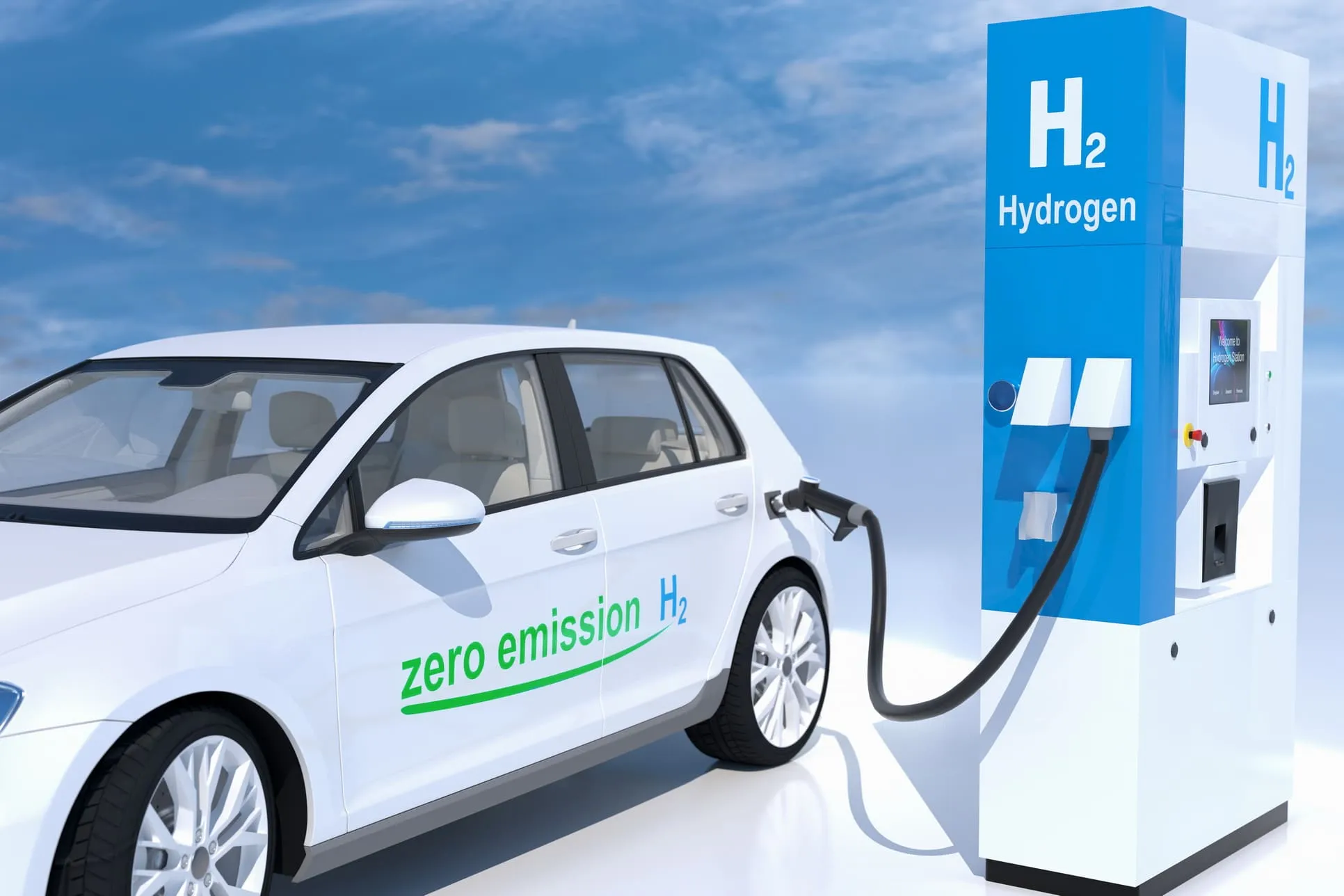
Hydrogen is the future of the automotive industry. You hear that everywhere. But will that really be the case? There are already many articles and videos on this subject. I thought the topic had actually been settled. So why this contribution? Well, there is still a great deal of disagreement, often based on weak knowledge. Even very well-known professors demonstrably put forward false arguments. What I want to give you in this video is a clear summary of all the arguments: arguments in favour of hydrogen fuel-cell drives becoming established, and arguments against them. So, will you and most customers be buying and driving hydrogen fuel-cell cars in 2030?
Klicken um YouTube-Video zu laden. Dabei wird Ihre IP an YouTube (USA) übertragen.
Datenschutz
There is this widespread, hopeful idea: in ten years, we will all be able to drive on hydrogen without any problems, refuel 800 km of range in a few minutes, and produce no local emissions at all. And everything will be fine. Battery-electric cars are therefore merely a temporary transition technology, so you might as well buy another combustion engine.
Germany now has a national hydrogen strategy. The vision is market leadership in hydrogen technologies. A clear vision and even a strategy to go with it — that is already impressive. Something otherwise lacking. But let us take a closer look.
We are looking at passenger cars and light commercial vehicles here — the vehicles that you and I mainly use. And we are considering them from the car buyers’ perspective. They are the ones who will largely decide whether the hydrogen fuel-cell car or the battery-electric car becomes established.
And one more thing: this is not a forecast for 2030, but my future assumption. That is an important distinction. Forecasts are supposed to predict the future in 2030. The forecaster wants to be exactly right in ten years’ time. A future assumption, however, means this: based on everything that can be known today, we assume the following future so that we can make decisions now. Then, in a month or a year, we review and correct our future assumption. And let me also say this: our clients in the automotive sector are all suppliers to the combustion-engine industry. Nobody is paying for this video. It is simply my assessment and that of FutureManagementGroup AG.
Why are combustion engines missing as an option? We addressed that in this article.
Balance of arguments
Let us draw up a balance of arguments. All these arguments have been put forward by experts and can be checked in the sources below.
Plus arguments support the view that car buyers will mainly choose HFCEVs (Hydrogen Fuel Cell Electric Vehicles, or hydrogen cars for short); minus arguments oppose it, meaning that most will choose BEVs (Battery Electric Vehicles, or battery cars). There are also zero arguments that apply equally to both types of drive.
When I use BEVs for comparison, I naturally mean today’s leading provider, Tesla, which presumably shows what the other providers will also be capable of in five or ten years.
Arguments concerning comfort
10 minutes to refuel for 500 km (Plus)
With five minutes to refuel for 500, 800 or later even more kilometres, a hydrogen vehicle can be refuelled considerably faster than a battery-electric vehicle can be charged.
Once a filling station has served one or a few vehicles, it needs another five to ten minutes before it is ready to refuel again — in other words, until the filling pressure has been restored. So only four to six cars per hour can be refuelled at one station. But for the foreseeable future, that is still faster than charging a BEV for 500 km.
A future disadvantage must not be overlooked. Even in ten years, FCEVs will probably not be able to refuel much faster than they do today. It will still take ten minutes. BEVs, however, will be able to charge considerably faster in ten years than they can today. The lead will therefore narrow. Solid-state batteries offering 500 km of range after five minutes of charging are still somewhat speculative, so we will leave them out here.
So this is a clear plus argument for the HFCEV.
Range comparable to a battery-electric car (Zero)
The range of HFCEVs is roughly equivalent to that of BEVs. The Hyundai Nexo has 540 km, the Toyota Mirai 500 km, the next generation even 650 km, and the Mercedes GLC F-Cell 500 km. Unfortunately, you can only lease the Mercedes, not buy it, and even then only if you have a company. For whatever reason. A breakthrough into the future would look different. Current electric cars are no worse in terms of range: Tesla Model 3: 560 km; Tesla Model S: 640 km.
Greater ranges can be expected from larger tanks or batteries and from efficiency improvements in both drive types equally. Announced FCEVs with ranges of 800 km and 1,000 km do exist, but such announcements also exist for BEVs: the Tesla Cybertruck with 800 km and Tesla’s Roadster with 1,000 km. So overall, this is a zero argument.
Refuelling only at filling stations (Minus)
You will never be able to refuel a hydrogen car at home, at a friend’s house or at all but the very few employers and customers — not even in 2030. You will always have to drive to a hydrogen filling station to refuel. A BEV is generally charged at home while you sleep, enjoy your free time or at work, with only the effort of plugging in and unplugging twice a week. That is entirely sufficient for almost all drivers, apart from long-distance drivers. They are the only ones who need to stop at a fast charger every three hours for 30 minutes, while drinking coffee, eating something and using the toilet.
A BEV is still genuinely problematic and challenging today for tenants without their own parking space. Charging options must therefore be created in public car parks, at supermarkets or at employers. Energy suppliers are very confident about the possibilities for expansion. I therefore assume, with good reason, that there will be major progress in this area over the next few years up to 2030.
You can basically charge a BEV from any socket, although very slowly — at around 13 km of range per hour. With one of the red CEE sockets rated at 16 A and 11 kW, which can be installed in practically any house or car park with little effort, you can charge 50 km of range per hour while sleeping, working or enjoying leisure activities.
The variety of refuelling options is also a long-term argument against hydrogen cars.
Hydrogen filling stations will remain much rarer (Minus)
Across Europe, there were 134 hydrogen filling stations in August 2020. Germany had 84, or 60% of all European stations. This means that you practically cannot go on holiday by car, because the remaining 50 hydrogen stations are spread across the whole of Europe: France 5, Austria 5, Switzerland 3, Belgium 2, the Netherlands 3.
But things will certainly improve in the future, won’t they? They might. You just need to know that building a single hydrogen filling station costs more than €1 million and that operation is also expensive, whereas a charging station with six to eight charging points costs one tenth as much — just over €100,000 — and requires hardly any maintenance. More on that later.
The current and probably future number of refuelling options is a minus against hydrogen cars.
Arguments concerning utility
The load space is smaller (Minus)
All the models available so far have a significantly smaller boot than BEVs, because a fuel-cell vehicle simply has to accommodate more components.
Well suited to sensible driving (Zero)
The performance of an HFCEV is entirely sufficient for sensible and relaxed driving. Just as it is with a BEV.
Less suitable for dynamic driving (Minus)
Anyone who wants a great deal of acceleration, and wants it frequently, will enjoy an FCEV less than a BEV. If you want acceleration from 0 to 100 in four seconds or less — something quite a few people still like — today’s HFCEVs cannot do it, because the small buffer battery does not permit sustained dynamic driving. And if the battery were larger, you could dispense with the fuel cell and the tank and have a BEV.
Safety is lower (Minus)
Hydrogen tanks are now just as safe as petrol and diesel tanks. But all three types of tank are more hazardous in a fire than batteries. BEVs catch fire at least five times less often than petrol and diesel combustion vehicles — in percentage terms, of course, not merely in absolute numbers. That is what the ADAC says. Some studies even say 20 times less often, measured per distance travelled. But let us stick with five times less often.
A hydrogen filling station has already exploded in Norway. A charging station has not.
Electricity is transported through power lines. Hydrogen must be transported to filling stations by tanker lorries — incidentally, ten times more lorries than are needed for petrol and diesel, as we will see later. Safety is therefore more of a minus argument against hydrogen cars.
Arguments concerning costs
Triple energy requirement (Minus)
Fuel cells are energy converters. First, electricity has to be consumed to produce hydrogen, and then the hydrogen has to be used again to generate electricity — each time with high energy losses and correspondingly reduced efficiency. For purely physical reasons, FCEVs can therefore never be as efficient as a battery that stores and releases electricity directly.
Even if FCEV technology makes major advances, we would have to discover new laws of physics to compensate for this efficiency disadvantage.
Footnote: It would actually be more efficient — and therefore more environmentally friendly and cheaper — to use the hydrogen at the filling station to generate electricity and use that electricity to charge electric cars. Leaving charging time aside.
There is also the direct combustion of hydrogen in combustion engines, which could work with some modifications. But it has an even lower efficiency, worse even than petrol and diesel. BMW, for example, abandoned this approach as early as 2009.
Second footnote: e-fuels achieve a maximum efficiency of 15%, so they are not an alternative for mass-market automotive transport.
There are various overviews comparing the efficiencies of combustion-engine vehicles, hydrogen fuel-cell vehicles and battery-electric vehicles, and every one of them is disputed in some details. If we look at the basic relationship, however, we can conclude that of the 100% of energy used at the source for an FCEV, around 20% to a maximum of 30% reaches the wheels.
Of the 100% of energy used for a BEV, around 70%–90% reaches the wheels. Based on my own experience, I would question the 90%, so let us assume 80%. The respective averages are 25% and 75%. This leads to the simplified statement that HFCEVs need three times more energy than BEVs. There are also calculations that arrive at five times as much energy. But let us leave that aside.
So anyone who asks where all the electricity for BEVs is supposed to come from and then demands that hydrogen must be the solution has quite obviously not done their physics homework.
Even if all cars in Germany were fully electric, Germany would need no more than 20% more electricity. Incidentally, one third of this 20% is already sold or given away to other countries today. But if all cars in Germany had hydrogen drives, we would need at least 60% more electricity. That would be an entirely different and enormous challenge.
How does this affect the female car buyer? Quite simply, the energy costs of an FCEV for the same distance inevitably have to be three times higher than those of a BEV. You do not need to worry about efficiency or whether the electricity is renewable. What will count is what comes out of the wallet.
Some people say efficiency does not matter if energy is abundant. First, we are still a long way from having abundant renewable energy; second, energy will not be free anyway. Who would voluntarily pay three times more when they can pay one third for the same performance?
Hydrogen production will become cheaper only if energy becomes cheaper. But electricity for BEVs will then also become cheaper to the same extent. If electricity becomes more expensive, both drive types will become more expensive to the same extent.
It goes without saying that the weight of the vehicles with both drive types is already included in these calculations. In any case, the weights now differ hardly at all. A Toyota Mirai weighs roughly as much as a Tesla Model 3 with the same range. Incidentally, a BMW 3 Series with a combustion engine also weighs almost exactly the same.
Energy efficiency, and therefore energy costs, are a very strong minus argument against the HFCEV.
The service life is shorter (Minus)
The best fuel cells have a service life of up to 450,000 km. Today’s batteries are similar, but Tesla will shortly introduce a battery for 1 million miles, or 1.6 million km, which will still have 70%–80% of its capacity afterwards. It is rather unlikely that fuel cells will make such a leap after decades of research.
Electric cars have also existed for a long time, but automotive lithium-ion batteries have not. Their development effectively began only about twelve years ago.
Batteries are very stable in practical use. In reality, an entire battery simply failing almost never happens. Fuel cells are more sensitive.
A battery is considered ready for a second life at 70%–80% capacity. It then serves for another ten or more years as a stationary storage unit in households or businesses. This second life is also fundamentally possible for fuel cells, but it begins earlier and is shorter than for batteries.
The result is that the roughly identical purchase price of HFCEVs and BEVs is spread over fewer years of drive-system life in the case of HFCEVs, meaning that depreciation per year is higher.
Depreciation is higher (Minus)
Depreciation depends on the purchase price and service life. We have already mentioned the service-life disadvantage. The purchase price, in turn, depends heavily on the components installed and the number of units sold.
BEVs are considerably simpler in design and can generally be built smaller than FCEVs. Most providers have not even started producing small BEVs. The potential for price reductions is therefore greater for BEVs.
In Germany, as of August 2020, there were just around 600 hydrogen cars on the road, but around 180,000 battery-electric cars. BEV numbers are growing strongly and exponentially. Tesla, many Chinese manufacturers, Renault, VW and others are strongly driving BEVs forward. FCVs are still developing very hesitantly, despite decades of research and development.
China has reduced subsidies for BEVs and will soon abolish them altogether. That is absolutely right, because the better option will prevail in the market anyway. Subsidies are almost always unnecessary and harmful. For the time being, however, China has only reduced subsidies for small BEVs with short ranges, so that the cars gain greater range and become more practical for everyday use. In China, combustion engines are to be fully replaced by BEVs. HFCEVs receive support only on a relatively limited scale. BEV numbers will therefore be enormously higher than FCEV numbers.
As a result, HFCEV buyers will experience higher depreciation per year.
Maintenance is more expensive (Minus)
FCVs are considerably more complex. They have everything an electric car has, plus a sensitive fuel cell, a high-tech tank and other specific components. Fuel cells have to be drained to protect them against sub-zero temperatures, preheated for operation and cooled during operation. The intake air must be very clean and heavily filtered to protect the cell membranes.
Fuel cells deliver constant energy most effectively. To allow your car to accelerate more strongly, and also to preheat the fuel cell, a battery is needed, albeit a very small one. The small battery in an HFCEV has to withstand far more charge cycles than a large battery in a purely electric BEV and therefore degrades faster.
The tank is now a technical masterpiece. After all, it has to withstand pressure of 700 atmospheres — 200 to 300 times more pressure than in your tyres. Although hardly any hydrogen now escapes through the tank walls, the tank is complex to produce and must be inspected and maintained. It takes up as much space as a diesel tank, even though it can store only a few litres. It is therefore clear that an FCEV cannot and will not be cheaper to maintain than a BEV, even in the long term.
Some people say that hydrogen cars are also promoted so that customers will continue leaving large sums of money at workshops. But these higher maintenance costs cannot be hidden from customers. They will recognise which drive system is more expensive and which is cheaper to maintain.
Infrastructure costs are much higher (Minus)
The cost of infrastructure — that is, the necessary amortisation of investments — will ultimately have to be borne by car buyers and drivers. Almost all of this infrastructure would have to be built from scratch, and quickly, whereas most of the electricity infrastructure already exists and only needs to be expanded gradually.
Hydrogen storage is dangerous and therefore heavily regulated. Production, transport and filling stations must be extensively secured and inspected. The legally required inspections and maintenance for a hydrogen filling station alone are said to cost more than half a million euros per year. Such costs do not arise anywhere near this level for charging points.
Unless hydrogen is produced directly at the filling station — which would increase the cost per station from one million to several million euros — it has to be transported to the station by lorry. The lorry also needs either 700 bar pressure or cooling to −253 degrees. Along the entire route. These are very expensive tanks and very expensive lorries.
A normal tanker lorry can transport considerably fewer kWh in the form of hydrogen than in the form of diesel or petrol. It is estimated that hydrogen mobility would require ten times more tanker lorries than today’s fuel supply to filling stations. All of them would be carrying fairly dangerous hydrogen.
Pipelines and the gas network are technically and physically out of the question because they would have to be rebuilt entirely for hydrogen — every centimetre using the expensive technology of the tanks. The existing gas network proposed by Prof. Lesch is completely unsuitable.
Instead of liquefying hydrogen using 700 bar pressure or cooling it to minus 253 degrees, one could bind it in organic substances such as dibenzyltoluene. This is known as a Liquid Organic Hydrogen Carrier, or LOHC. Although this could save the cost of compression or cooling, efficiency would be considerably worse because the hydrogen would first have to be bound and then extracted again. The car would also need a huge tank, further reducing efficiency. And the number of tanker lorries would be many times greater again.
Conclusion: because hydrogen requires extensive and expensive infrastructure for production, transport and thousands of filling stations, its costs can practically never be anywhere near as low as the cost of supplying electricity to BEVs.
That does not matter to the customer, you say? Well, he or she has to pay for all of it. And customers become very critical and cautious when that happens.
Arguments concerning the environment
100% renewable energy is possible for both (Zero)
Like BEVs, HFCEVs can potentially be operated using 100% renewable energy. This is therefore a zero argument that applies to both drive types.
Both types of vehicle can also fundamentally be manufactured using renewable energy. That, however, still lies well in the future, even though Tesla has announced that it will manufacture batteries using renewable energy within a few years, entirely without a CO2 backpack.
The carbon-dioxide burden is the same (Zero)
Today, batteries are produced only partly using renewable energy, while hydrogen is currently obtained mainly from natural gas. For the time being, therefore, there are problems on both sides. Both have the potential to be produced and operated without CO2 emissions.
A Fraunhofer study commissioned by H2 Mobility says that HFCEVs are more climate-friendly than BEVs from a range of 250 km onwards. But the commissioning party is a hydrogen consortium. And it recommends building both technologies side by side. Customers will have to choose: HFCEV or BEV. Unfortunately, CO2 emissions will not be the central criterion.
And should a complete hydrogen infrastructure really be built despite the existing electricity infrastructure? Only to supply some of the cars while the others charge with electricity? Economically speaking, that makes little sense. From the customers’ perspective, comfort, utility and cost will be decisive.
Since both cause similar CO2 emissions and can potentially become CO2-neutral, I assess this as a zero argument.
Fewer critical raw materials (Plus)
HFCEVs can be credited with a less critical raw-material situation. The main material discussed is platinum, and its use has already been greatly reduced.
There is an extensive and largely emotional raw-material debate around BEVs. The most compelling argument concerns the relatively small proportion of cobalt obtained through illegal child labour. Child labour is unacceptable from our point of view, full stop! However, cobalt is a by-product of copper production, so practically the entire electronics industry would have to be accused. It only became an issue with BEVs. It is important to know that the cobalt content in modern batteries has already been reduced to one sixth, and batteries without cobalt are expected.
The drinking-water consumption associated with lithium extraction is demonstrably a misrepresented problem. Eleven avocados or two beef steaks require exactly as much water as a large battery for an electric car. There is also enough lithium on Earth to electrify all cars — all the more so with a 95% recycling rate. Finally, lithium will not be an essential battery element for ever. Incidentally, batteries contain no rare earths at all.
Let us retain the somewhat emotional plus argument for the HFCEV.
A 95% recycling rate is possible for both (Zero)
Batteries can be recycled to 95%, because even after 500,000 km or 1 million km, everything that was put into the battery is still there. Let us assume that the same applies to fuel cells and hydrogen tanks, although there is little information on this. The only problem is that there are and presumably will be far more BEVs than FCEVs, so investment in recycling capacity is more likely to pay off for batteries.
A cautiously fair zero argument.
Arguments concerning the future of the automotive industry
Market success has so far failed to materialise (Minus)
What does the current market reality look like? Most car manufacturers are clearly focusing on BEVs as the successor to the combustion engine. Yes, there are still a few exceptions, such as Toyota and Hyundai. But they are few, and their sales figures are already drastically behind those of BEVs. Even with the brand-new and quite attractive Mirai, Toyota, the world’s largest car manufacturer, plans to sell only 30,000 units.
In Germany, despite having over 60% of Europe’s hydrogen filling stations, there are currently just 600 FCEVs on the road. But already around 180,000 BEVs.
The growth rate in Germany from 2018 to 2019 was 64%, compared with 54% the year before. Worldwide, it was 42% and 55%. The exponential growth is clearly visible. Market share is also growing exponentially. HFCEVs are being left far behind.
Almost everyone who has once owned a modern BEV whose manufacturer has organised the charging infrastructure well — at the moment, that is only Tesla, with others soon to follow — stays with it after experiencing it in the market and no longer switches to a combustion engine or an HFCEV.
Unless a comprehensive hydrogen infrastructure suddenly emerges now, including in other countries — something that can virtually be ruled out — the race has already been decided. Twenty years ago, this opportunity still existed, when nobody knew how to build batteries with such high energy density and reliability. But now? Probably not.
Political energy independence is delayed (Minus)
If we genuinely want to become independent one day from the not particularly pleasant suppliers of crude oil and from the far-from-environmentally friendly oil industry, we should not choose a system that requires three times as much renewable energy. With FCEVs, our chance of achieving strategic energy independence would recede into the distant future.
Limited prospects of success in the global automotive market (Minus)
Some people demand that German and European manufacturers should not commit to BEVs because so many jobs would then be lost. They are supposed to focus on FCEVs in order to save jobs at car manufacturers, suppliers and engineering companies. I can hardly believe that an alleged automotive-market expert genuinely believes this. But he has written it publicly.
The proposal, then, is: let us do the complicated, inefficient and expensive thing so that we can save our industry. Somehow, we will be able to sell it to customers that they have to pay much more, continue visiting the workshop more frequently and can refuel at only a few stations. Business as usual.
I can understand this argument. Many of our clients are suppliers to the combustion-engine industry and mechanical-engineering companies. But this would be a very short-sighted and ultimately suicidal strategy. Why? After considering all the arguments, hydrogen mobility is the more expensive and less convenient solution for customers. The automotive industry would therefore have to force or entice most of its customers into it. Trust is already strained as it is.
That could work if there were no competitors. It is not only Tesla and many other Western manufacturers that are relying on BEVs. China wants to replace combustion engines entirely with BEVs. HFCEVs play virtually no role there, for precisely the reasons examined here. Who would we sell our hydrogen cars to around the world, and how, if hardly anyone outside Germany is even considering building an adequate hydrogen infrastructure?
Customer acceptance is lacking (Minus)
Since car buyers are generally not stupid and look closely, the German automotive industry would commit suicide by focusing on hydrogen. Customers would continue driving their combustion vehicles and then gradually switch to BEVs, which German industry would then offer in insufficient numbers.
What previously seemed unimaginable could then easily happen: we would begin buying significantly more cars from China. They are excellent at electric cars. Take a look at Volvo’s new Polestar. It is a Chinese car!
If the German automotive industry actually tried to sell customers a system that was more expensive in several respects and less convenient, we would not save a single job. Because of global competition from BEVs, we would achieve exactly the opposite: we would lose most jobs.
Fortunately, however, the automotive industry is better informed and more sensible than some alleged automotive experts. It is already leaving hydrogen on the sidelines.
Conclusion and future assumption
Some people will now say that it is better not to buy a car at all. Yes, hardly anyone needs a one- or two-tonne vehicle to get from A to B. But people want and buy passenger cars — at least for now, until autonomous vehicles arrive.
This is about passenger cars and light commercial vehicles. Yet even Nikola, the aspiring hydrogen-truck manufacturer that has never built more than a prototype, has included purely battery-powered trucks in its so-far-imagined product range. Why is that?
Hydrogen is far too expensive, and therefore too valuable for use in passenger cars and probably trucks as well. Hydrogen has significant benefits and great potential in many stationary industrial applications. Efficiency is also considerably higher in stationary operation. As a reducing agent in the steel industry, for example, hydrogen would greatly reduce CO2 emissions, because carbon monoxide from burnt coal is currently used.
Alongside stationary industrial applications, ships and aircraft could be very good applications for transport and mobility.
Even if, after decades of research and substantial public funding, we succeeded in making hydrogen production more efficient and cheaper and found investors for thousands of hydrogen filling stations within a very short time, we would still have to discover new laws of physics for a hydrogen car to become better and cheaper for customers than a purely battery-electric car.
The idea of seeing a mix of FCEVs and BEVs as the future is nonsensical. Even for only half the vehicles to be FCEVs, the full infrastructure would be needed. The cost disadvantages would become even greater.
So if you read adverts such as “Tesla overtaken long ago — here are the secret tips for hydrogen stocks”, I would definitely keep my distance.
My future assumption — not a forecast — is therefore that in 2030 customers will buy neither diesel or petrol combustion cars nor hydrogen cars, but battery-electric cars by a wide margin. And that providers will follow this trend.
What do you think? Do you have any further or better arguments? I look forward to your comments.
If you find my assessments convincing, share this contribution with your friends and acquaintances and on social networks. That way, we can take a more realistic look at the future and make better strategic decisions in our companies.
By the way, if you want your company to benefit from the trends and technologies of the future and develop and implement a robust future strategy, I invite you to my Leader’s Strategy Program. In it, I advise and support you in rethinking and building the future of your company.
I wish you a bright future!
Have a bright future!
Sources
Overall assessment
- Prof. Doppelbauer on electromobility — condensed: Doppelbauer_-_Elektromobilitaet-komprimiert__2_.pdf
- Passenger cars 2.0 — The car is being reinvented — YouTube: watch
- Strategy paper on electric cars: Strategiepapier%20Elektroautos%20Stand%202019-10%20V1.5.pdf
- Waiting for the hydrogen car — but the technology has no chance against batteries: https://www.focus.de/auto/elektroauto/news/efahrer-chef-erklaert-warten-auf-das-wasserstoff-auto-darum-hat-die-technik-keine-chance-gegen-akkus_id_11365397.html
- Hydrogen car — technology, availability, tests — ADAC: wasserstoffauto-so-funktioniert-es
- VDE fuel-cell study: studie-brennstoffzelle-data.pdf
- Do hydrogen cars have a future? — Spektrum der Wissenschaft: 1523803
- Myths about the hydrogen car — The truth about the fuel cell — auto motor und sport: wasserstoffauto-brennstoffzelle-co2-neutral-batterie-lithium
- Status of electromobility 2020 — The endgame after the coronavirus crisis: 341670568_Status_Elektromobilitat_2020_Das_Endspiel_nach_der_Corona-Krise
- The raw-material shortage is being overcome — Energy transition: Finally abolish the fuel-cell car! energiewende-schafft-endlich-das-brennstoffzellenauto-ab-2006-149263-2.html
- Fuel cell — a billion-euro grave for car manufacturers — Auto & Mobil — SZ.de: alternative-antriebe-die-brennstoffzelle-ist-ein-milliardengrab-fuer-autohersteller-1.3922234
- Hydrogen cars, fuel cells — the next big thing after the botched energy transition: wasserstoff-autos-brennstoffzelle-das-naechste-grosse-ding-nach-der-verpatzten-energiewende
- Hydrogen — an energy future or an expensive dead end — can LOHC help? — YouTube: Wasserstoff – Energetische Zukunft oder teure Sackgasse – Hilft LOHC? – YouTube
- Fuel cell in cars — better than lithium batteries — Harald Lesch — YouTube: watch
- Prof. Lesch and the public-service media — science or red-green mouthpiece? — YouTube: watch
- Harald Lesch on electric cars — old figures, old myths — YouTube: watch
- Harald Lesch is wrong — Why the fuel cell is not the future — EFAHRER.com: Harald-Lesch-irrt-sich-Warum-die-Brennstoffzelle-nicht-die-Zukunft-ist_10815
- Dibenzyltoluene as the hydrogen storage medium of the future — HZwei Blog: dibenzyltoluol-als-wasserstoff-speicher-der-zukunft
- Liquid organic hydrogen carriers — Wikipedia: Fl%C3%BCssige_organische_Wasserstofftr%C3%A4ger
Energy requirements and energy costs
- Nikola Plans to Enter the Market at an Uncompetitive Price Point, & More — ARK Invest: issue-226
- Which is more efficient — battery or hydrogen: battery-or-fuel-cell–that-is-the-question.html
- VW — electric cars are much more efficient than hydrogen vehicles: vw-elektroauto-brennstoffzelle-wasserstoff
- Electric road transport — battery vs fuel cell vs Power-to-X — Zukunft Mobilität: elektroauto-brennstoffzelle-synthetische-kraftstoffe-ptx-ptl-kosten-infrastruktur-rohstoffe-energiebedarf-wirkungsgrad
Safety
- How safe are hydrogen vehicles? — EMCEL: sicherheit-von-wasserstofffahrzeugen
- Norway — explosion at hydrogen filling station — electrive.net: norwegen-explosion-an-wasserstoff-tankstelle
- Status and Q&A regarding the Kjørbo incident — Nel Hydrogen: status-and-qa-regarding-the-kjorbo-incident
- Air Products and Chemicals, Inc. Tube Trailer Module Hydrogen Release and Subsequent Fire: HZM1902.pdf
Environment
- Fact check — Which car has the best climate and environmental footprint? index.php
- Climate footprint of electricity-based drives and fuels: klimabilanz-von-strombasierten-antrieben-und-kraftstoffen-1
- Study — GHG emissions from battery and hydrogen passenger cars: treibhausgas-emissionen-batterie-wasserstoff-studie-fraunhofer-ise
- Electric car, diesel or hydrogen — How do we stop the climate crisis? — YouTube. Elektroauto, Diesel oder Wasserstoff – Womit stoppen wir die Klimakrise? – YouTube
- Fuel-cell service life — information on durability: lebensdauer-einer-brennstoffzelle-infos-zur-haltbarkeit_97643
Market
- ZSW — number of electric vehicles grows to 7.9 million: zsw-bestand-an-e-fahrzeugen-waechst-auf-79-millionen-exemplare
- Electromobility — number grows to 240,000 electric vehicles: elektromobilitaet-bestand-waechst-auf-240-000-e-fahrzeuge
- eMobility dashboard July — 16,798 pure electric passenger cars: emobility-dashboard-juli-16-798-reine-elektro-pkw
- 2021 Toyota Mirai fuel-cell sedan reveals striking new look: 2021-toyota-mirai-revealed
Future of the automotive industry
- Researchers — fuel cells are highly beneficial ecologically: forscher-brennstoffzelle-oekologisch-sehr-sinnvoll
- Only hydrogen can save the German automotive industry: nur-wasserstoff-kann-die-deutsche-autoindustrie-retten
- Mechanical-engineering association believes in hydrogen drive: maschinenbauverband-betont-potential-von-wasserstoff-antrieben
- Hydrogen as the fuel of the future: 25192302.html